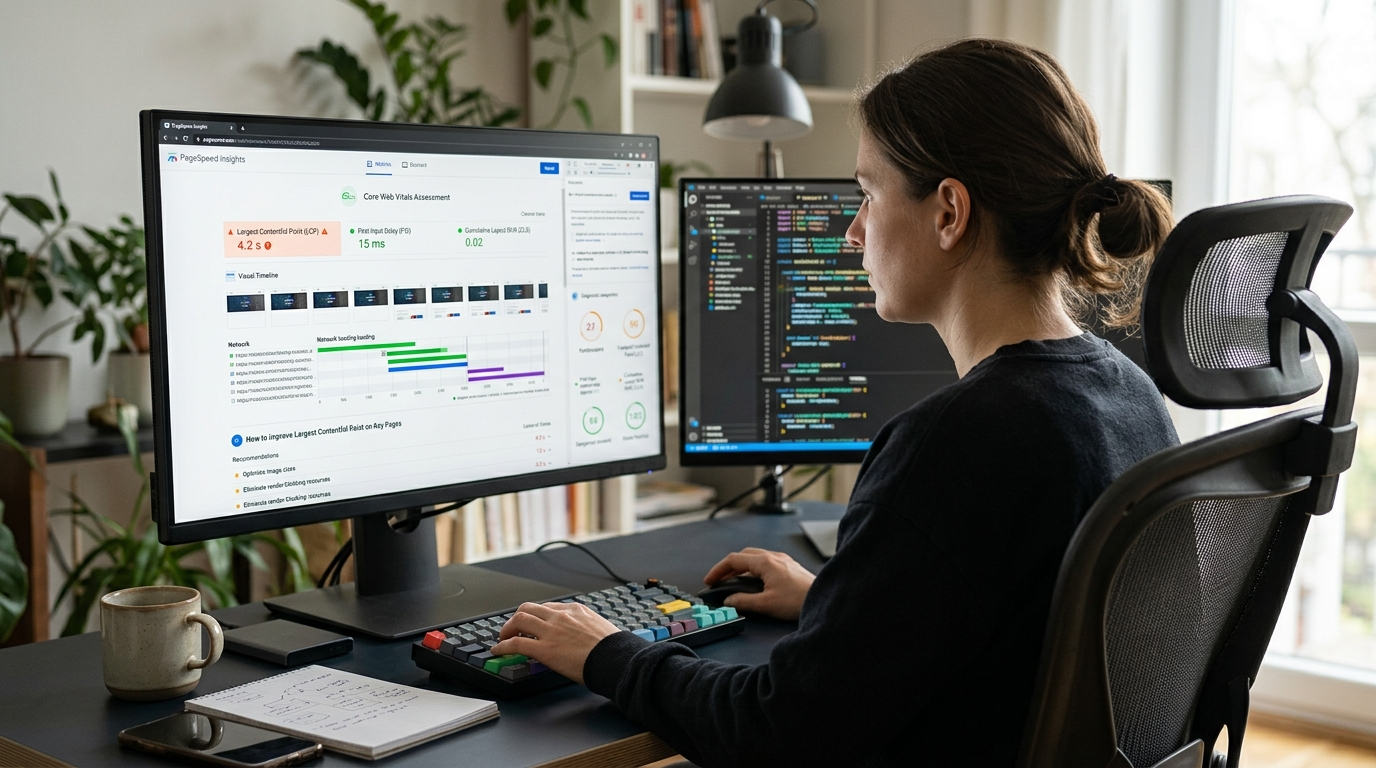
Unexpected layout movement makes pages harder to read and interact with. Cumulative Layout Shift, or CLS, helps quantify this instability, but the fix starts with the exact shifting element.
Observe the movement in context
Use performance traces or visual debugging tools to identify the element and its preceding cause. A headline may jump when a web font swaps in or a banner appears. Do not assume the visibly moving element caused the shift.
Reserve image and media space
Provide intrinsic dimensions or a stable aspect ratio for photographs, videos and embeds. A 16:9 article card should reserve its box before the image arrives. Lazy-loaded images without dimensions can shove text downward.
Treat ads and embeds conservatively
Allocate predictable space for third-party content or place it where sudden expansion is less disruptive. An embedded media panel can occupy a pre-sized region while loading. Injecting an unpredictable banner above the article is disruptive.
Handle fonts with layout in mind
A narrow heading container can reveal a large shift after typeface substitution. Use sensible fallbacks and compatible metrics to limit reflow when web fonts change. A font strategy that hides text may also damage perceived performance.
Avoid late UI insertions above content
Place consent banners or notifications as intentional overlays or reserved areas when appropriate. A dismissible notice can sit below the header without moving the article unexpectedly. Overlays still need keyboard and screen-reader support.
Watch expanding components
Provide space or a predictable animation for accordions, tabs and validation messages. A form can reserve a status region for errors near the relevant field. An animated height change after a click is not always an unexpected layout shift.
Test across breakpoints
Check mobile widths, localized strings, zoom settings and device orientation. A card title that wraps to four lines may change the height of a grid row. A desktop fix may introduce mobile overflow.
Verify after content edits
Images, promotional modules and third-party embeds can reintroduce shifts later. New editorial modules should use the same dimension rules as existing cards. Layout stability requires component standards, not a one-time cleanup.
Interpret the metric correctly
Review field trends as well as controlled reproduction of the problem. A shift triggered by a late image may be more important than minor font movement. Not every intentional change during user interaction is counted as unexpected CLS.
Apply this guide
Reload a page with slow network throttling and watch the header, images and banners. Add dimensions or reserved space where late content pushes existing elements.
Documentation and next reading
Official and primary documentation worth checking for current behavior, requirements and limitations: